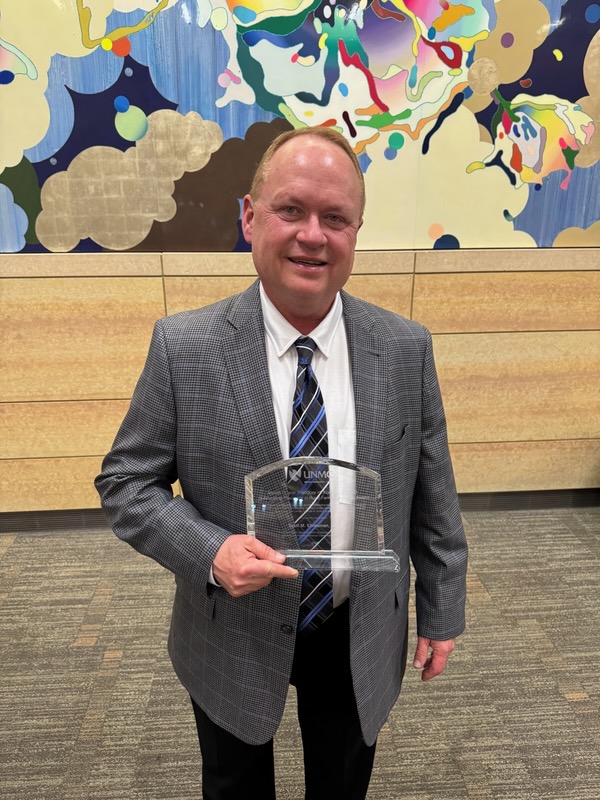
A full-circle moment has come for Dr. Scott Ehresman.
First recognized as the inaugural recipient of the Marion D. and Theodore H. Koefoot, Jr., M.D. Outstanding Preceptor in Rural Family Medicine Award in 2006, Ehresman has once again been honored in 2026, two decades later, for his continued dedication to mentoring the next generation of physicians.
In addition to this recognition, he was also named the 2026 recipient of the Excellence in Clinical Teaching Award from the University of Nebraska Medical Center’s College of Allied Health Professions, further highlighting the impact of his work with students across disciplines.
For Ehresman, the recognition has never been about individual achievement.
“It means a lot. It’s very special,” he said. “Any time I’ve received an award, I feel very humbled and appreciative, but this really isn’t about me. It reflects everyone here. The providers, nurses, hospital team. We all contribute to making the experience meaningful for students.”
While Ehresman is quick to share the recognition, his leadership has helped shape the teaching environment that so many students experience during their time in Holdrege, leaving a lasting impact on the physicians they become.
A physician at Family Medical Specialties in Holdrege for more than 35 years, Ehresman has long served as a preceptor for medical and physician assistant students, guiding them through hands-on clinical experience in a rural setting.
In many ways, Ehresman serves as the connector, helping ensure students gain exposure to a wide range of providers, settings, and patient experiences.
“From the moment students arrive, we make sure they learn from everyone,” he said. “They spend time with multiple providers, PAs, and even the emergency room team. It’s a group effort, and I’m very grateful for the commitment everyone has to teaching.”
For many students, those experiences are more than just part of a rotation. They are meaningful firsts. Whether it is stepping into a delivery room, caring for patients across all stages of life, or navigating real-time decision making, the moments they encounter in a rural setting often stay with them long after they leave.
Beyond the clinical setting, Ehresman is intentional about helping students feel at home during their time in Holdrege. From taking them along on nursing home rounds to showing them around the community and sharing favorite local spots to eat and explore, he makes an effort to ensure they experience not just the practice of medicine, but the community itself. It is a reflection of the personal investment he brings to each student, and the passion he has for helping them grow, both as future providers and as people.
That collaborative approach is one Ehresman has helped build over the years, creating an environment where teaching is not just expected, but embraced across Family Medical Specialties and throughout the hospital, extending his impact far beyond any single rotation.
Ehresman also credits the community itself as an essential part of that experience.
“Our patients play a big role too,” he said. “They’re incredibly kind and willing to be part of the learning process. That makes a big difference for students.”
Over the years, he has worked with countless students, many of whom have gone on to become physicians across the region and, in some cases, right back in central Nebraska.
“One of the most rewarding things is seeing former students come back,” he said. “Whether they join our group or practice as specialists in the region, that’s really special.”
While not every student chooses rural family medicine, and most don’t, Ehresman hopes they leave with a deeper understanding and respect for it.
“I want students to understand that we practice high-quality medicine in rural communities,” he said. “We care for patients at every stage of life and across a wide range of needs, and we take that responsibility seriously.”
He also emphasizes the importance of collaboration and communication across all areas of medicine.
“No matter what specialty they go into, we want them to work well with others and respect the role of referring providers,” he said. “We’re all part of the same team, working together for the patient.”
At the heart of his teaching philosophy is a simple but powerful principle.
“We try to practice golden rule medicine, treat others the way you’d want to be treated,” he said.
After more than three decades in practice, Ehresman says working with students continues to bring energy and meaning to his work.
“Students are fun. They bring enthusiasm and a fresh perspective,” he said. “They keep things interesting, and you build relationships with them that last.”
That passion for mentoring is rooted in his own experience as a student, shaped by the physicians and teams who once guided him.
“I still remember being a student myself and the people who helped me along the way,” he said.
It is a role he has carried quietly for decades, shaping not only individual students, but the culture of learning that surrounds them.
And while the recognition may bear his name, Ehresman remains clear about what it represents.
“This is something we all take pride in,” he said. “It’s a team effort.”
And in doing so, he continues to shape not just individual careers, but the future of healthcare itself.