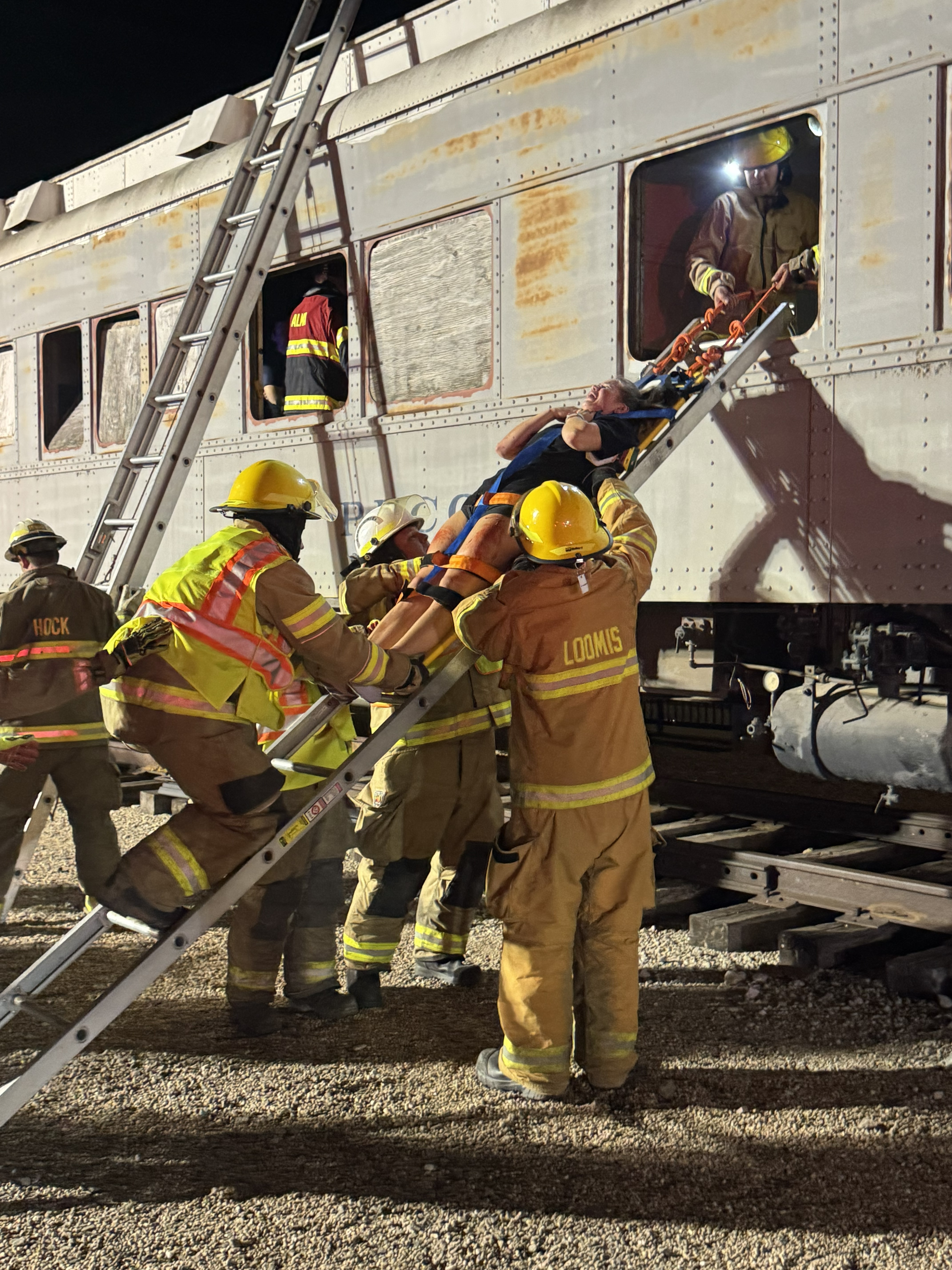
In the darkness, six first responders carried an injured passenger away from a train toward a triage area where medical teams waited to assess injuries and provide care. On the backs of their gear were the names of five different fire departments. For Marlene Williams, an advanced emergency medical technician with Phelps Memorial Emergency Services and one of the event’s organizers, that moment captured the purpose behind months of planning.
“As I watched the six carry the patient, I read the back of their bunker gear, realizing five different fire departments were represented in that transfer,” Williams said. “All acting as one! That summed it up for me.”
The patient was a volunteer. The emergency was simulated. But the teamwork and lifesaving skills being tested were real. On Aug. 21, Phelps Memorial Health Center hosted its annual mass casualty incident training, bringing together 120 first responders from 28 agencies across Nebraska. Nearly 30 volunteers portrayed victims during the full-scale passenger train emergency exercise in Holdrege. Through its partnership with Amtrak, Phelps Memorial Emergency Services combined specialized education with a realistic nighttime response to a simulated passenger train derailment.
“The value of partnering with Amtrak is that we aren’t simply creating a train derailment scenario, we are bringing the railroad into the exercise as an operational partner,” Williams said.
The evening began at the Holdrege City Auditorium, where Amtrak Regional Emergency Manager Kerinne Monaco presented “Amtrak Be Prepared, Plan and Train Today.” The presentation introduced responders to railroad operations, passenger car layouts and safety considerations unique to train emergencies.
Unlike a typical motor vehicle crash, a passenger train emergency can involve multiple railcars, elevated windows, unfamiliar interiors and hazards associated with electrical systems, fuel and nearby train traffic. Responders learned how passenger cars are configured, including sleeping compartments, dining areas, stairways and restrooms. The training also addressed emergency access points, window removal and communication with railroad dispatchers to ensure other train traffic has stopped before responders enter the tracks.
The information carried particular local relevance because Holdrege is a stop on Amtrak’s California Zephyr route. According to information shared during the presentation, 1,710 passengers used the Holdrege station during fiscal year 2025.Wade Williams, AEMT, presented an initial triage refresher addressing one of the most critical components of a mass casualty response. When numerous people are injured, responders must rapidly assess each patient and prioritize treatment based on injury severity and available resources. Paramedics Shelby Hudson and Alex Brush discussed crush injuries, helping participants recognize and manage injuries that can occur when passengers are trapped or pinned during a derailment. Wes Hock, NSFMT, provided instruction on rope rescue safety, introducing a technique unfamiliar to many participants. Using ladders, a Stokes rescue basket and an anchored rope-and-pulley system, responders learned how to safely lower a patient from an elevated train car window.
Following the presentations, responders moved to the Holdrege Amtrak station to put their training into practice. Nearly 30 volunteers helped bring the scenario to life. Before the exercise, they received simulated injuries created with moulage makeup and information describing the injuries and behaviors they would portray. Each victim also had a tag identifying injuries responders would need to assess. As the exercise unfolded, volunteers called and cried for help, creating the confusion and urgency of an actual emergency. One volunteer portrayed a deceased passenger and was formally pronounced dead within the scenario by Corey O’Brien, Phelps County attorney, who served as the coroner on scene.
Holding the exercise after dark added challenges that would not exist during a daytime drill. “Nighttime MCI training can be much more challenging and realistic because darkness changes almost every part of the response,” Marlene Williams said. “There is limited visibility; navigating the scene is very difficult in the dark.”
Responders worked to locate passengers, identify injuries, position equipment, establish triage areas and account for personnel while navigating limited visibility and unfamiliar surroundings. “I think the biggest lesson is in the daytime we ask ourselves, ‘Can we accomplish this mission?’” Williams said. “In the nighttime, ‘Can we accomplish this mission when we can’t easily see what we are doing?’”
The exercise also allowed participants to apply the rope rescue techniques. Responders inside a railcar secured a patient in a Stokes rescue basket and moved the patient through a train car window. A rope rescue team lowered the patient to personnel on the ground, who completed the transfer to triage. The Holdrege Volunteer Fire Department also used its ladder truck and aerial bucket to extract a patient. The equipment offers another option for reaching passengers if a railcar is on its side or positioned in a way that prevents responders from using conventional exits.
Dallas Roemmich, member of the planning committee and Holdrege Fire Chief, said the ladder truck is especially valuable for rural departments, where fewer responders may be available during an emergency. “A crew of three can have the truck set up and operating in a matter of minutes, which ultimately could make the difference between life and death,” Roemmich said. He also highlighted the collaboration on display throughout the exercise. “Being at the live training and seeing people be able to work together without even knowing each other’s names, let alone ever meeting before, is something the members of the community don’t recognize,” Roemmich said. “Whether you’re Fire, EMS, or both you can walk away from a training like this with real world skills and the confidence to hopefully be prepared when training becomes life's reality.”
Phelps County Emergency Manager Justin Norris served as incident commander, coordinating personnel, communication and resources among participating agencies. “Practicing together before an actual emergency allows everyone to understand their roles, responsibilities, and expectations before the pressure of a real incident,” Norris said.
The exercise reinforced the importance of clear communication, defined responsibilities and a unified command structure when multiple agencies respond to the same emergency. “The biggest takeaway was that we may come from multiple different agencies, but with good communication, coordination, and unified command, we can function as one team,” Norris said.
Participants attending the Aug. 21 event received six hours of EMS continuing education. An additional Amtrak Passenger Train Emergency Response training on Aug. 19 provided two hours of continuing education for those who attended.
For Marlene Williams, the exercise was about building confidence among the people and agencies that will work together when an emergency occurs. “My hope is that everyone left with the confidence that they can work through a large, complicated incident,” Williams said.
For Phelps Memorial Health Center, the training represented an investment in the first responders who serve communities across Nebraska and the partnerships that help keep the region safe. By the end of the night, responders walked away with more than just training hours. They gained confidence, teamwork, and the assurance that if an emergency strikes, they are prepared to act together.